Monday, December 14, 2015

Irupu Falls in Coorg - a weekend getaway!

-----Published in Women's Era Nov 2015 (2nd issue)-----

If you are looking for possible extended-weekend getaway options around Bangalore, you must surely consider visiting Irupu Falls in Coorg. This is about 260 kms from Bangalore and roughly involves a 6-hour drive. There are several homestays available; infact, most of the coffee planters around here have done up their homes and built in additional rooms, to be let out to eager tourists.  The prices are reasonable, the stay is pleasant and comfortable (do not expect any 5-star facilities.)  This will be ideal for friends or families travelling together.  One can, literally switch off completely (as the network connectivity in these parts is very poor), de-stress and relax, and enjoy the natural beauty of the place while breathing in the fresh mountain air.

We were two families of cousins who travelled together in April.  We set off quite early (around 4:45 AM) from Bangalore and escaped the weekend traffic. We stopped at Mysore for breakfast and proceeded to Irupu Falls taking the Hunsur- Gonikoppa route. We passed through the outer edges of the Nagarhole Forest and hoped to see some wild animals, but only got a glimpse of a few tamed elephants in a camp.
At the Homestay
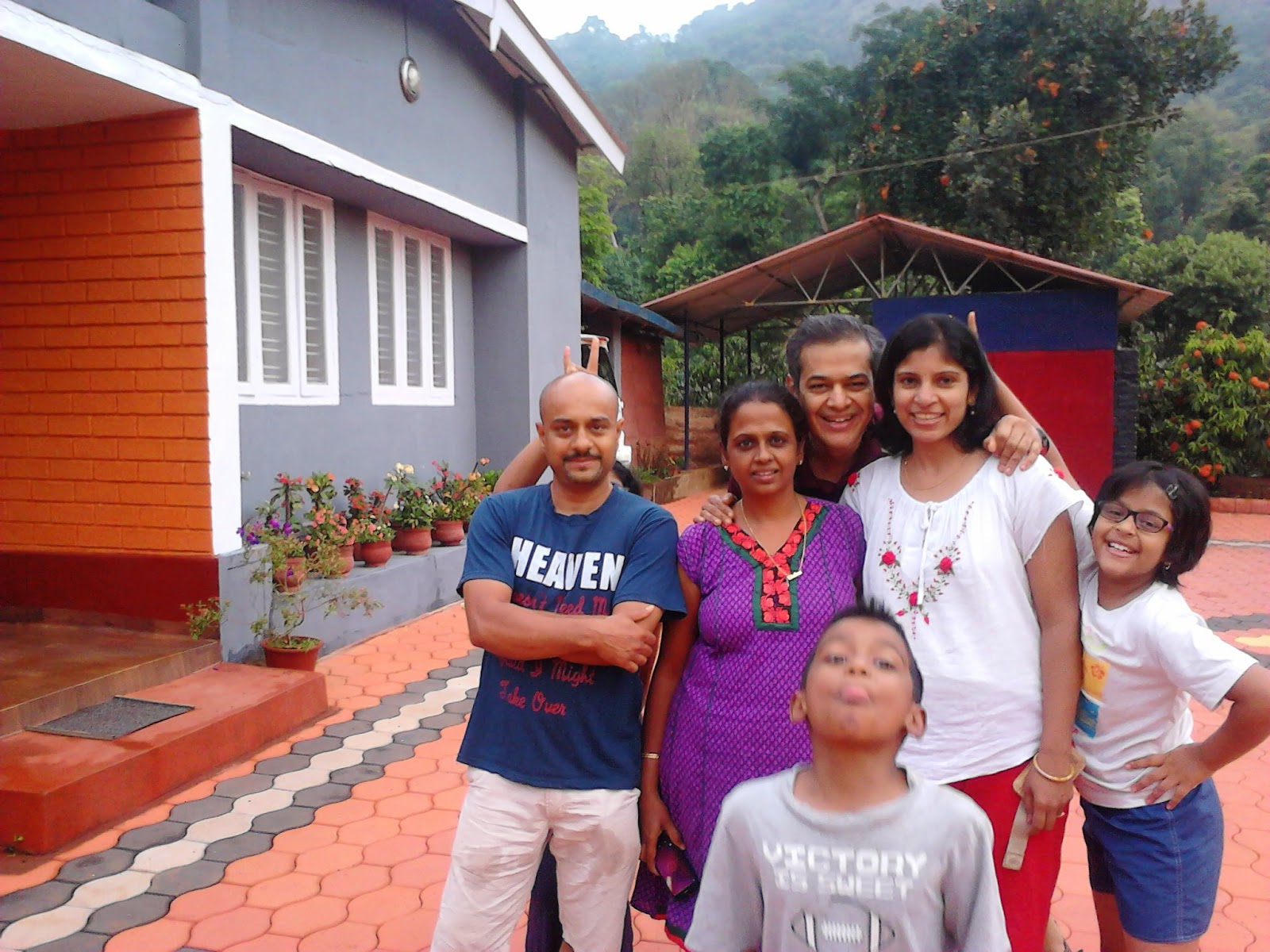
The road was good (the last time we took this road, there were more potholes than road) and we reached our Homestay by 11:00 AM.  This was just about 500 metres from the entrance to the Falls.  Our hosts (who were in their mid-60s) greeted us warmly. We spent some time taking in the surroundings - the house and the garden were well maintained and our Host showed us around, pointing out the different trees and plants.  After a good homely lunch, we played a round of boisterous basket ball without following any of the rules - there was lots of grabbing, pulling, running around with the ball and a good amount of healthy laughter! :-)


Evening sky
In the evening, we took a leisurely stroll and visited the Irupu Rameshwara Temple.The evening sky appeared like a beautiful painting - as though someone had gently stroked his brush across the wide canvas with different shades of orange, crimson and blue.  The temple appeared to be placed right in the lap of the valley, surrounded by hills on all sides.  It is a lovely structure set in a wide expanse of area; the main deity- a Shiva lingam - is enshrined in a circular enclosure and looked very appealing.
After the soul enriching temple visit, we walked back; the local dogs kept us company, and guided us back to the Homestay.  We had a wonderful barbecue dinner, sitting around a bonfire and making merry of the night.  Jokes, comments, wise cracks, music and dance kept us in a jolly mood and not to forget the lovely food cooked for us by the lady of the House.  Definitely, this was the stuff of the heavens!
Irupu Falls!

Hanging bridge - Irupu trail
The next morning, after a good jog, we headed to the Falls armed with extra clothes and towels.  We were the first visitors of the day and so had the Falls to ourselves for nearly an hour. The walk, a gradual climb actually, from the entrance to the Falls is about 750 m.  A hanging bridge adds to the sense of adventure. The legend goes that Lord Rama and Lakshmana visited this place while on their way to Lanka.  Rama felt thirsty and asked Lakshmana to fetch some water who immediately shot an arrow into the hills and thus emerged the Irupu Falls to quench Rama's thirst!  Due to this, it is also known locally as Lakshman Thirtha!

Posing under the Falls
As we walked the trail, we could hear the water even before we got to see it.  The water cascading from the top fell over two levels and appeared like sheer, frothing, white milk.  The water was refreshingly cool and soothing and removed all our runner's fatigue.  The force of the water was a little overwhelming for the children but provided a free massage for the adults. After a while of fun and frolicking and posing for crazy photos, hunger pangs hit us and so we headed back to the homestay. The only problem we had was the lack of proper changing rooms near the Falls.

Back at the homestay, we ate a sumptuous breakfast consisting of a local delicacy called kadubu. Our hostess explained that these were rasgulla like baked soft balls made of rice rawa served with a tasty coconut chutney. 

Monkeying around in Kuruva Island
We then decided to explore the region and drove up to neighboring Wayanad.  The drive was beautiful - we could only see greenery all around us and it was absolutely soothing to the eye.  We visited the Kuruva Island - an uninhabited space adjacent to the back waters of the Kabini river, surrounded by mangrove bushes, gigantic bamboos and trees of several other species. We had to take a barge to cross the river and reach the island.  Being a weekend, the place was crowded and the people far outnumbered the trees!  We sat near the river bank for a while.  I am sure it would have been a much better experience had there been fewer people around. Well, so much for calling it "an uninhabited island"!

We stopped at a restaurant called Hill Top Hotel and had 'Tunch', a combination of Tea and lunch, as my daughter calls it! We then headed back to the homestay, and spent some quality family time, playing cricket, cards and carrom board.  I was glad that there was no TV or internet connectivity; all of us - children and adults - were forced to bond without any distractions and what better a place than in the middle of a coffee estate, surrounded by nature.
A book, a swing, and greenery= Total relaxation!
Dinner was again a very hearty meal, made and served lovingly.  Even the poor eaters in the family had built up a good appetite and enjoyed the food immensely.

The next morning we again wanted to visit the Falls to enjoy the natural shower.  But we opted out and instead played basketball and badminton.  After a good breakfast, we set out on our return journey to Bangalore. We stopped on the way to pick up mangoes (the first of the season), had a late lunch at Kamat Lokaruchi and were back home before sundown.

The trip to Irupu Falls was a lovely 3-day break, cathartic to the soul and left us completely rejuvenated!


Sunday, August 23, 2015

A photo tour of the animals around the Mantralayam temple


As we sat on the banks of the river Tunga, waiting to witness a beautiful sunset, we got to see several animals.  It is such an uncommon sight for an urban dweller to see so many animals sharing the eco-space of a small town, merging with the background and contributing to enjoying the whole rural experience!   Here are a few of our four-legged brethren that we were able to capture on camera.


Buffaloes taking a leisurely stroll on the river bank


A lonely dog walking on the paved stones!


We found quite a few pigs (several black and a few white) in Mantralayam town - this one was walking on the river bank.  Looks like it is wearing 2 pairs of  tiny heeled slippers!


the Temple elephant


Close-up of the Jumbo!


Snake Kalia - a sculpture of Krishna dancing on the snake.
We saw other animals too - cats, cows, more dogs, pigs and piglets, donkeys.. but didn't get a picture of them.  The pigs and donkeys were definitely the attraction - after all, you don't get to see them in cities now.

Bangalore to Mantralayam - by road

Entrance to the temple
We had been wanting to visit the Raghavendra temple in Mantralayam for quite some time.  What with the whole family being busy - the husband travelling or generally being  occupied on weekends, with daughters having some event, project or activity at school - we were unable to plan a trip.  Finally out of the blue, when we found a weekend when everyone was free, we decided to head out to Mantralayam.  Railway tickets are very rarely available and on a weekend, definitely not; so we set out by road.

A beautiful stone sculpture at the entrance
Mantralayam is 408kms from our house in Jayanagar (as given by our car's odometer) and the roads are pretty good.  We set out early by 5:30 AM and hence had the road to ourselves.  We took the National Highway 7- the Hyderabad route - stopped at Chikbalapur's Kamat Upachar restaurant for breakfast.  It was quite decent.  We crossed Anantpur, Gooty and then took the state highway towards Pattikonda; passed by Adoni, Yemmiganur and reached Mantralyam by 12:30 pm - a good 7 hours drive with a couple of stops for breakfast and mid-morning tea.

We booked a room at the Temple Trust - we got a 3-cot bed which came in handy for our family of 3 adults and 2 children.  We had also carried pillows and bed sheets with us (the luxuries of travelling by car) and so could manage a good night's sleep on the not so well-washed hotel bedding.  We visited the temple and headed straight to lunch (as the last batch was at 2:00 pm).  There is something to be said of the lunch served in temples - it may be a simple fare but all of us ate heartily, especially my little girl who relished the sweet-tasting sambhar and rasam.  Back in the room, we rested for a while and then set out to the temple to have our darshan of Raghavendra Swamy.  It was quiet and peaceful when we went in, not much of a crowd; we could enjoy the peace and tranquility of the place and feel one with the Lord.

Sunset on the banks of the Tunga river
We also visited the Tungabhadra river, but were disappointed to see nothing but rocks with no trace of a river flowing.  We sat on the banks and witnessed the sun-set while listening to the recorded voice of the Temple security person (we possibly heard it close to 20 times!!) alerting pilgrims to be wary of pick-pockets and thieves in all 5 languages - Telugu, English, Kannada, Hindi and Tamil.   We also saw several animals walking past the river bank, serenely and peacefully, doing whatever they had set out to do.

the Rathotsava in progress
When we returned to the temple, it was packed - it being a second-Saturday, lots of holiday goers were present.  Also, several had come to see the Rathotsava that was held around 7:30 pm.  A beautiful sight it was, with the colorfully be-decked and garlanded Utsava murthy, placed on chariots - first on the silvery-white elephant and then on the traditional wooden one - and pulled around the temple shrine.  We expected the devotees to use ropes to pull the chariot, instead found that the chariot was motorized - so no tugging and pulling, just a quick circle of the outer shrine.

After witnessing  the beautiful ceremony, we then found out that they also served dinner at the temple and so headed to the Bhojanalaya to have our simple but tasty dinner of rasam rice and curd rice. While sitting in neat rows for the food to be served, we could not but be in awe of the service rendered by the temple authorities and more so by the cooks who serve food day in and day out for the thousands of devotees visiting the temple everyday - truly inspiring and amazing work!

the Utsavamurthy atop the silver elephant
The next morning, we again visited the temple and prayed to Raghavendra Swamy and Lord Hanuman - who appeared more like Hayagreeva as the horse's facial outline plate that is put on the Lord's chest stood highlighted.  With prayers to visit again, we bid goodbye to the temple town of Mantralayam and made our way back to Bangalore.   We took the same route on the return trip but we spent nearly 8 hours, possibly because of the later start.  Lunch on the way was a challenge as we did not find decent places to eat.  We finally stopped at the same Kamat restaurant in Chikbalapur where we'd had our breakfast earlier.

So all in all, it was a pleasant 2-day trip; we collected memories and enjoyed the family time, and ofcourse, returned as rejuvenated souls!
    

Monday, May 18, 2015

An unforgettable road trip through Delhi, UP, Uttarakhand

During the summer vacation of April 2013, we planned our holiday to north India.  My daughter had learnt quite a bit about Mughal history and so we thought it the right time to visit the places that she had read about.

It turned out to be a beautiful vacation - fun-filled,educative and taking us back in history to the Mughal era.  It packed in varied experiences - from watching the historic relics in New Delhi, to witnessing the soul-stirring and peaceful 'aarti' of the holy Ganges in Haridwar, to enjoying the thrill of river rafting in Rishikesh, to following the pug marks of the majestic Indian tiger in Jim Corbett National Park, to seeing the birthplace of Lord Krishna and finally to be bewitched by the eternal beauty of the Taj Mahal in Agra.

The highlight was the road trip - we hired a self driven car from CarzonRent; and with a vehicle at our disposal, we covered the 3 states of Delhi, Uttarakhand and Uttar Pradesh over 12 days and drove nearly 1,300kms.
New Delhi-Mussorie-Rishikesh-Haridwar-Jim Corbett Park-Agra-New Delhi


New Delhi - We spent the first 4 days in Delhi visiting all the landmark monuments and places like Qutub Minar, Raj Ghat, Humayun's Tomb, Red Fort, India Gate, Rashtrapathi Bhavan, The Lotus temple, The Swami Narayan temple, the Birla Mandir.  Some of the unique sights and offerings that we enjoyed and relished were

Qutub Minar
  • the Red Fort Sound and Light show - we watched the evening show; it was a fascinating walk back into the pages of Indian history
  • the Change of Guards ceremony at Rashtrapathi Bhavan (this takes place every Saturday morning).  We jogged from India Gate towards Rashtrapthi Bhavan on the historic Rajpath road and were lucky to catch the Change of Guards ceremony!
  • the amazing street food like Dahi Bhalla, Channa Bhature, Lassi in Chandini Chowk & the Haldirams restaurant.
Uttarakhand - From Delhi, we drove to Mussorie via Dehradun.  It was a long drive, took us nearly 7 hours; we took it slowly, enjoying the villages and small towns that we passed through. We picked up peaches from Meerut and they tasted amazing.  We stayed in Mussorie for 3 nights,relaxing and enjoying the cool weather and the beauty of the landscape.

Highlights of the Mussorie trip -
On the steps leading to Mr. Ruskin Bond's house
Watching the IPL match at a wine store
  • We visited Mussorie's most famous writer, Mr. Ruskin Bond's house in Landour, in the fond hope of meeting the legend in person.   But unluckily for us, we chose a wrong time.  His house keeper informed us that he was in the middle of his afternoon siesta and could not be disturbed.  We had to satisfy ourselves with a glimpse of the hills and dales of Mussorie that he usually sees and writes so magically about in his books.  
  • We played cricket in the resort that we stayed in and spent a considerable amount of time  searching for the ball!
  • We took a walk around the Mall area.  It was the day of the IPL match between Royal Challengers Bangalore and Pune Warriors and the kids wanted to watch the match.  We did not have time to get back to the resort to see the match, so all of us stood around the TV in a small Wine store and cheered Chris Gayle as he stormed his way to an unbeaten 175*.  RCB ofcourse, won the match!  A Police constable was curious and came to check what 4 children (all minors) were doing in a wine store.
We then proceeded to Rishikesh, stopping enroute at Sashasthra Dhara,the sulphur springs.

Highlights of Rishikesh and Haridwar -

All hands aboard - white water rafting!
A view of the Ganges
  • The Lakshman Jhula bridge - one of the engineering marvels built way back in 1929 is a suspension bridge and is nearly 450 ft long, and offers spectacular views.  We walked across the wide bridge and stopped for pictures and to see the Ganges placidly flowing by.  The wide expanse of the river is an ideal spot for white water rafting and we spotted several rafts below.  We contacted an operator and opted for the beginner's level which has 3 rapids and covers a distance of 9 kms.  We first drove upstream in the operator's jeep, to the starting point called Brahmpuri, walked down to the river bank, fitted ourselves in life jackets and equipped with an oar each, got into the raft.  It was quite an adventure and we got a thrill when we maneuvered our raft successfully over the rapids.  Towards the end, we also had a chance to swim alongside the raft, and found the waters of the Ganges to be refreshingly cold!  
  • Evening aarti of the Ganges - This was a beautiful experience.  In the evening, we sat on the steps leading to the river; quite a crowd had gathered there - locals and tourists like us- to witness the religious ritual.  As the sun sets and the skies darken slowly, several pundits join together to sing bhajans, recite mantras and wave the aarti plates with the flame gently billowing in the breeze, praying for the divine blessings of the sacred Ganges! 
  • Visiting the Manasa Devi temple in Haridwar taking a cable car ride to reach the top of the hill to see the shrine.
In tiger country - Jim Corbett Park
Next stop in our itinerary was the lush green forests of Jim Corbett National Park in Ramnagar, close to Nainital, home to the Bengal tiger. We took the jeep drive into the forest and eagerly hoped to meet the elusive tiger but it remained elusive.  We missed seeing it by a mere few seconds and had to be satisfied with seeing its pug marks and hearing its roar.  The children (and adults too) were a tad disappointed but well, that is life!  We enjoyed the scenic beauty and drove along watching the River Kosi meander its way through the hills and valleys.


     Uttar Pradesh 

A view of the Taj from Shahi Darwaza
  • We then left the hills and drove towards Uttar Pradesh.  It was a long drive; we first stopped at Mathura to see the birth place of Lord Krishna - a lovely temple has been built here.  We also visited Gokul (which is about 10 kms from Mathura). Not many tourists take this stretch , and we understood why; the road was totally in disrepair and the 10 km stretch seemed to go on forever.  The home of Yashoda and Nanda where Krishna grew up, is badly maintained and definitely not worth the effort.
  • Agra is a wonderful city; the club that we stayed in dated back to the British times and the rooms were BIG by any standard.  We visited the Taj Mahal early in the morning ( to avoid the heat and rush bound to be there later in the day) and had a great time looking at the majestic relic of love.  Even though we had seen it before, we were still struck by its sheer beauty, the eye for detail and the dexterity of the masons who built it.  Everything was in perfect uniformity and in proportion.  All of us were astounded and started talking about the kind of effort that would have gone in in building such a fine marvel, back then when there were no machines or tools/technology.   
  • The Yamuna Expressway - We took this highway on our trip back to Delhi and covered the 165 km stretch in 2.5 hrs.  But we had a hell of a time getting on to the Expressway; the boards were highly misleading and asking people for directions led to more confusion!

This is one road trip that will be etched in our memories. We faced a few inconveniences but they were all worth it and enriched our overall experience; and I am sure, if given a chance, we will again jump at doing this!


Saturday, October 26, 2013

The Ngornongoro Crater - a memorable trip inside a mountain!

That's the Ngorongoro Crater!
We have heard of mountains, and volcanoes and also learnt about craters. We have also studied about volcanic eruptions releasing magma, molten lava and such other stuff.  But we were surprised to learn about volcanoes that while exploding, collapse inward and form huge basin-like structures. These are called calderas or cooking pots.  
The Ngorongoro Crater is a fine example of the cooking pot. It must have been a fairly big volcanic mountain 2 or 3 million years ago, but then it exploded and collapsed on itself, thus forming a basin that is around 600m deep and has a floor area of 260 sq.km!

Standing on the rim of the crater
Wildebeest!
Our first sight of this magnificent, natural wonder near Arusha in northern Tanzania, was breath taking!  It was nothing even vaguely similar to what we had imagined it to be.  We stood at the rim of the crater and looked down upon the sprawling open grassland forming the floor of the crater.  We could see tiny black specks dotting the green below.  We trained our binoculars on these black spots and realised, much to our amazement, that they were wildebeests and zebras!   We could also see a lake - called Magadi.  This is the water source to all the animals that live here.

Another view of the crater
We halted at the campsite and pitched our tents.  The camp site has been set up right on the rim of the Ngorongoro Crater and commands a panoramic 360 * view of the collapsed mountain. It has a wonderful, lush growth of grass.  Our two girls ran around, chasing each other, giggling and laughing and finally collapsing on the ground and rolling around in the grass.    The campsites are equipped with a common kitchen and a dining room apart from separate set of wash rooms for men and women.  Ceneal, (name pronounced as Kenail) our cook on the trip, got busy in the 'kitchen' and set up a wonderful meal for us. His hot soup accompanied by freshly roasted peanuts and popcorn was more than welcome to beat the sudden chill of the evening.  After dinner, while we slept in the tent, we suddenly heard chomping noises. We opened the flap a wee bit to peer out - a few wild bison were feeding on the grass right outside our tent.  We remained quiet within, lest any movement disturb the giants.  Our guide Milkauroy (pronounced as Milcure) informed us the next day that this was a common phenomenon.  The bison could not eat the lush sweet grass growing at the campsite during day time thanks to people like us being around. But at night, they would venture out from around the slopes and enjoy their midnight meal!

Don't mess withe me!


The striped herbivores!


Early next morning, even before sunrise, we drove down towards the crater floor to view the animals that had made this caldera their home.  A chill wind blew and made us all shiver despite our sweaters.  Apart from elephants, wildebeest, zebras ,lions, we got to see the African Black Rhino and the extremely shy cheetah during our 3 hour ride. A family of wart hogs, scampering around and frolicking, made for interesting viewing.  We could also observe several colourful birds like the Crowned Crane - Uganda's national bird, the delicate and gentle flamingos around the lake, the big-framed deer called Eland (this kind of resembles our native sambar deer), dik-diks (the smaller, dainty looking deer), Thomson's gazelles, a family of lions sleeping and totally oblivious to the several pairs of eyes staring at them in rapt attention.  We waited a while, hoping that the lions would move or look up but they continued to doze.. Finally, Milkauroy emitted a loud lion cry - a deep-throated roar.  The lioness, surprised, immediately looked up to see if the lion had indeed come and must have surely been disappointed to see good old Milkauroy instead!.
Enjoying our coffee in the middle of the Crater

We then stopped for a picnic breakfast near the lake and spent some time  exchanging pleasantries with the hippos! And what a royal breakfast it was!  Ceneal had packed sandwiches, cake and fruit for us.  Milkauroy set up the folding table and chairs.  He even spread a table cloth (the typical Masai shawl) and placed the plates and cups on the table!  A flask of hot water ensured that we could have coffee while the girls enjoyed their hot chocolate drink.  It was a truly memorable picnic, out in the open with several birds for company, and watching the hippos immersed in the swamp water with just their heads sticking out!
The girls near the hippo swamp
Our guide Milkauroy with the girls and the picnic table


On the drive back to Arusha, we enjoyed watching the beautiful landscape pass by - we were driving down a straight, ribbon-like road and it seemed like we would go and bump straight into Mount Meru that was sitting right at the end of the road!  That was a truly awesome sight!

The Ngorongoro trip was a wonderful experience  - the memories of which we will all cherish in our hearts. Did someone say, "Wanna go again? You bet! I am ready for it anytime!

To Arusha - approaching Mount Meru 

Wednesday, November 21, 2012

Sun, Spices and Slaves - welcome to Zanzibar!


At the airport, after landing in
JAMBO (Hello) Zanzibar! 

A view of the Indian Ocean - a play of green!
When I first heard of Zanzibar, I could only remember it as the Spice capital, having read something in school history about this being an island nation having a flourishing spice trade. But ofcourse, I found out there is more to this island than just what I recalled.

We flew in to Zanzibar from Arusha in northern Tanzania; the flight was a small 40-seater plane run by a private airline called Flight 540.  The view from 20,000 ft. above, as we approached Zanzibar, was spectacular - clear green waters of the Indian Ocean, dotted with small land masses filled with lush green vegetation.  As the plane descended, it seemed as though we would touch down on water but magically, a land mass appeared and we landed into Zanzibar.  The moist, slightly cool breeze welcomed us as we stepped onto terra firma and made our way past the Customs officials.  

We found a taxi and headed into town.  The driver was a friendly chap and went by the name of Ronaldo. He further explained that his real name was Mohammed Naroor but took the pseudonym of Ronaldo after his favourite football player to ensure that European and American tourists find it easy to pronounce and remember his name!  His car had a sun roof and my daughters were happy opening and closing it.  The island was green, and beautiful; it reminded me instantly of Kerala and Goa. We could catch glimpses of the sea through the trees as we drove through the town.  Most of the women wore a head-dress, a shawl-like cloth that covered their heads and neck and fell down to the shoulders.  We passed through a road called Bu-Bu-Bu Road, named so after the train that used to run there in earlier times.  The area sported a Bu Bu Bu Police Station, and a school named, - yes, you guessed it right - Bu Bu Bu School!  My girls kept on rolling the name on their tongues and found it very funny!
Habib, pointing out the vanilla pods

Walking through the plantation
The Spice Girls, with their crowns!
Our first stop was at a Spice plantation - it definitely felt like we were in Kerala.  The guide there named Habib, spoke decent English and took us on a tour of the estate and pointed out various spices.  We played a Guessing game, look at the plant and identify the spice.  Our Guide was impressed by our knowledge of spices -  turmeric, ginger, pepper (called pili pili manga in Swahili), vanilla, cardamom.  He twisted  a few strands of leaves and made them into lovely objects - tapioca leaves (called cassawa, locally) became a necklace, the pineapple plant leaves transformed into glasses while he made crowns from coconut leaves.  My girls were mighty impressed and laughed gleefully when he placed mini crowns on their heads; we gave them nice titles to go with the crowns - "the Spice Girls"!     He then showed us the lipstick plant - it had a pod that gave a reddish orange colour gel when squeezed.  My younger daughter loved it!  She coloured her lips orange and enjoyed the natural lipstick. Habib also wanted to show us how to climb the coconut tree - but of course, coming from India, we were quite familiar with that as well, much to his disappointment!  We also got to see the cinnamon tree - the leaves are used as bay leaves, while the bark of the tree is the cinnamon.  Amazingly, the root smells of menthol and is used for medicinal purposes.

A view of the beach
After the tour, we headed to our hotel in the northern part of Zanzibar called Amaan Bungalows. Our room had a wonderful view of the beach.  In fact, the balcony stood on four wooden pillars erected right on the beach.  A white sandy beach, whitish water on the edge,  light green waters forming the next layer and dark green waters extending till the horizon - it was a truly spectacular sight!  I have never seen such green waters before - finally understood the meaning of turquoise!  We had a very pleasant dinner in the restaurant which was also situated right above the beach - hearing the movement of the waves and listening to the waters gently lapping against the pillars!  Ah, that was heavenly!
 
Gently moving with the sails unfurled
Enjoying a swim!
Beautiful sunset over the Indian Ocean
The next day, April 15th, was my elder daughter's birthday - it dawned bright and beautiful.  Her younger sister kept wishing her every few minutes, much to her annoyance!  We made the day extra special for her by playing in the waves and then going on a Snorkeling and sunset cruise.  One of the locals introduced himself as Captain and offered to take us on the cruise.  He asked, "you from India?".  When we answered "Yes", he immediately commented heartily with a funny accent, "Mujhe kuchchu kuchchu hota hay"!  We were all amused and admired his PR skills!  So, we went along with the Captain in his dhow, plunged into the middle of the Indian Ocean wearing life jackets and snorkeling gear and  explored the colourful  fish and coral of the sea.  My younger daughter jumped in too and had a whale of a time! After a good hour of this, we got back to the boat and sailed with the sails unfurled.  It was wonderful especially when the wind caught the sails and we swayed gently.  The sunset was spectacular!  The western sky turned  red, and orange  in varying degrees until the sun submerged into the sea, leaving us all clapping and sighing at the magical and breathtaking beauty we had just witnessed.

Walking down towards the Slave Cave
Inside the dark cavern
The next day, after a morning run on the beach and a nice, hearty breakfast, we checked out of our hotel.  Ronaldo,our friendly cab driver was waiting for us - he took us to see the sights of Zanzibar. First stop was the Slave Cave.  When we got down, we were not sure if we were at the right place.  There was no one around except for a young jeans-clad boy in his late teens. The place looked deserted and we did not see any rocky caves around.  Ronaldo then introduced the boy as our guide and asked us to proceed on the Cave tour while he waited in the car.  We hesitantly followed our young guide who spoke haltingly in English. He took us down a few steps and that was when we saw the cave.  The rugged steps reached down into a dark hollow cavern; we needed to use torches to light our way down.  The story was that while slave trading was being abolished, the Arab kings continued to deal with them.  They used to house the slaves - nearly 100 or more - in the cave.  This had a secret exit that opened  close to the sea - the slaves would be made to exit from the cave through this secret opening and board onto waiting ships to carry them away.  We wanted to walk through this entrance but our guide said the path was not big enough to go now.  We would have to crouch really low in some places to make it to the other side.  After spending a few minutes inside and listening to his story, we then went out and followed him across a path with shrubs growing on either side.  After a brief time, he stopped and showed the exit of the cave from where the slaves were forced to come out.  The sea was some distance away from there, but we vividly imagined how it would have been in those days - the poor men and women chained at the hands and legs and made to slowly walk the path in the dark, their heads bowed in pain and agony, forced to leave their homes to board ships to take them to far away lands where they would live a life of bonded labour and slavery!  


Our guide, inside the Slave chamber
The narrow lanes of  the old Stone Town
The outside view of Christ Church Cathedral
After the Slave Cave tour, Ronaldo then took us to the Old Stone Town - the lanes here are extraordinarily narrow; we could only walk or ride a cycle/two wheeler. We stopped at the most visited place - the erstwhile slave market which now houses the Christ Church Cathedral in its premises.  We climbed down to the dungeons of the old building after carefully minding our heads - this led to the chamber where the slaves were detained before they were auctioned.  It was a hideous place - small and narrow with no windows.  It had a raised platform where people were forced to sit and wait their fate.  There were 2 rooms on either side - one for the men slaves and the other to keep the women and children. Small square openings in the wall acted as ventilators - the room was otherwise dark and dingy.  There were hooks laid in the walls - presumably to chain the slaves.  Seeing the place sent shivers of revulsion down our spine.  What agony those people must have endured to be treated worse than cattle!  Thanks to the relentless efforts of the missionary David Livingstone, who travelled to and stayed in Zanzibar,  slavery was finally abolished in Africa.  We then proceeded towards the citadel that was constructed to commemorate the abolition of slavery. On the way, we passed by the place where the actual slave auctions used to be conducted.  In its place, a pit has been constructed which has clay figurines of slaves - their hands tied behind their backs and chains around their necks! The sight was stomach-wrenching.
In memory of the slaves - a heart wrenching sight!
The altar of the church is supposedly built right on the spot where the whipping staff used to be!  This church has a tall spire but is still a little shorter than the Palace's tower. The story goes that the local king, while providing approval for building the church, insisted that the spire should not be taller than the tower of his palace.

Inside the House of Wonders!
We then visited the Palace which is situated a few meters from  the pier.  This has now been converted into a museum and is called the House of Wonders as it was the first building in the area to have electricity and an elevator.  It has one of the biggest door frames at the entrance.  A big sized sail boat is laid out in the middle of the front room.  We hurriedly went around the rooms, glancing at exhibits as we were running late.  Apparently, the shortest war in history took place here between the British and the Arab King and it lasted about 38 minutes; the Arab king surrendered quickly to the British forces.  A part of his palace,the stables and other neighbouring buildings were ruined in the bomb attack but the same were renovated subsequently.

The white buildings of the palace as seen from the ferry.
Prior to reaching the Palace, we walked through the narrow lanes, looking at the architectural design of the buildings.  We could find some examples of the Indian style as quite a few Indians - mostly Gujaratis- came down to Zanzibar in the 1800s. We stopped at a couple of shops to pick up T-shirts featuring Zanzibar and other knick-knacks.   After the Palace tour, we stopped at an Indian restaurant for a quick and simple lunch of  rotis, dal and sabji.  It was served hot and was very delicious.  After lunch, Ronaldo dropped us at the jetty point and we took the last ferry back to Dar-es-Salaam.  Aboard the ferry, as we started sailing slowly away from Zanzibar, we could see the white buildings of the palace clearly, as they stood silently and solemnly, looking out to the sea - a mute witness to history!  Kwaheri (Goodbye) Zanzibar!